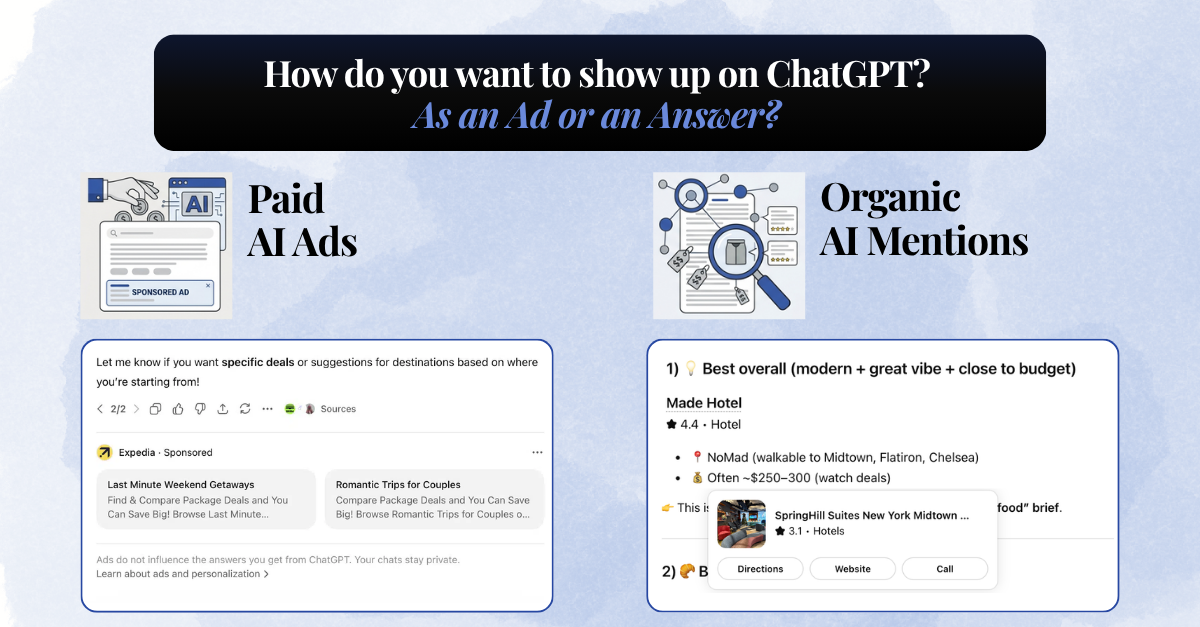
In the AI era, the best ad is not being an ad.

AI marketing is splitting into two worlds! Pay to show up below the answer vs. Earn your way into the answer itself. What should you do?

5 min read
A Mega Marketing perspective
AI Marketing is splitting into two worlds

Paid AI ads

OpenAI launched ads in ChatGPT in February 2026. OpenAI's ads pilot surpassed $100 million in annualized revenue in under two months.

Here's what the early data shows:

$60
CPM is significantly higher than traditional display
0.91%
Click-through rate is roughly 7x below Google Search's 6.4% benchmark. You're paying roughly $6.60 per click for clicks from free-tier users, with limited proof they convert
Free & Go
Ads are only shown to Free and Go tier users. Every paying subscriber (Plus, Pro, Enterprise) is permanently excluded. That means advertisers are reaching ChatGPT's least engaged users while the power users never see their ads

But are these ads purely to drive clicks? The value proposition of AI search engines was to provide the answer without having to click on any links. So would the users run to click on the sposored ads? Additionally, An Ipsos survey found that 63% of U.S. adults say ads in AI search results make them trust the results less.

Just like how Advertisers are rushing to advertise on CTV/OTT channels with higher CPMs and inherently don't drive clicks. Similarly, This can be viewed as a brand awareness channel and as the platform's ad network matures with conversational ad formats, this can be a viable channel. But right now the performance case is thin.

If that's the case, let's check out the other world.

Organic AI visibility

Now look at the other path.

ChatGPT's shopping feature recommends products by crawling the web in real time, checking prices, reviews, specs, and availability. When it recommends your product, it shows up as part of the AI's curated, personalized answer. Not as an ad below it.

The differences are significant

01 — Reach
Shopping results reach ALL users
Free, Go, Plus, and Pro. No audience ceiling.
02 — Trust
The recommendation carries the weight of impartial AI judgment
Not a paid placement.
03 — Conversion
Users referred from LLM platforms convert at 1.5x the rate of other channels
— Criteo data
04 — Commerce
Instant Checkout is already live
Users can buy from Etsy sellers inside ChatGPT, with Shopify merchants (Glossier, SKIMS, Spanx, Vuori) coming soon. Target, Sephora, Nordstrom, Best Buy, Home Depot, and Wayfair have already integrated.

This approach works across every AI platform, not just ChatGPT. If your product data is clean and authoritative, you show up in Gemini, Claude, and whatever comes next.

This isn't a free lunch either: only 17% of users start product searches in AI today, and ChatGPT's own product matching had a 63% error rate last year.

For consumer brands

If you sell consumer products, the organic route is almost certainly your higher-ROI play right now.

Because your goal isn't just impressions. It's being the product the AI recommends when someone says "find me the best running shoes under $150" or "what's a good gift for a coffee lover."

That recommendation is more trusted than an ad. It reaches a better audience. And when agentic commerce scales, where AI agents make purchases on behalf of users (24% of AI users already do this), the agent isn't going to click your ad. It's going to pick the product with the best data, the best reviews, and the clearest fit for what the user asked for.

If I were a CMO of a consumer brand, here's what I'd prioritize:

  1. Audit your AI visibility right now. Search for your product category across ChatGPT, Gemini, and Perplexity. Do you show up? How are you described? What competitors appear alongside you?
  2. Fix your product data. Implement Schema.org markup. Write descriptions that emphasize use cases, not marketing speak. Make sure pricing, specs, and availability are consistent across every channel.
  3. Integrate with commerce protocols. OpenAI's Agentic Commerce Protocol (built with Stripe) lets users buy inside the chat. If you're on Shopify, it's practically a toggle switch. If you're not integrated, you're invisible at the moment of purchase.
  4. Invest in being citable. Earn mentions in the review sites, publications, and comparison content that AI systems treat as authoritative. This is the new link-building. Except instead of ranking on Google, you're being recommended by AI.
  5. Then, and only then, test paid AI ads with a small learning budget. Treat it as R&D, not performance marketing. The platform will improve, and having early data will be an advantage.

The brands that win in the AI era won't be the ones who spend the most on AI ads.

They'll be the ones the AI genuinely believes are worth recommending.

Meghana Rangarajan
MBA Candidate, Kellogg School of Management, Northwestern University, IL, USA
meghanarangarajan@gmail.com
MEGA MARKETING